
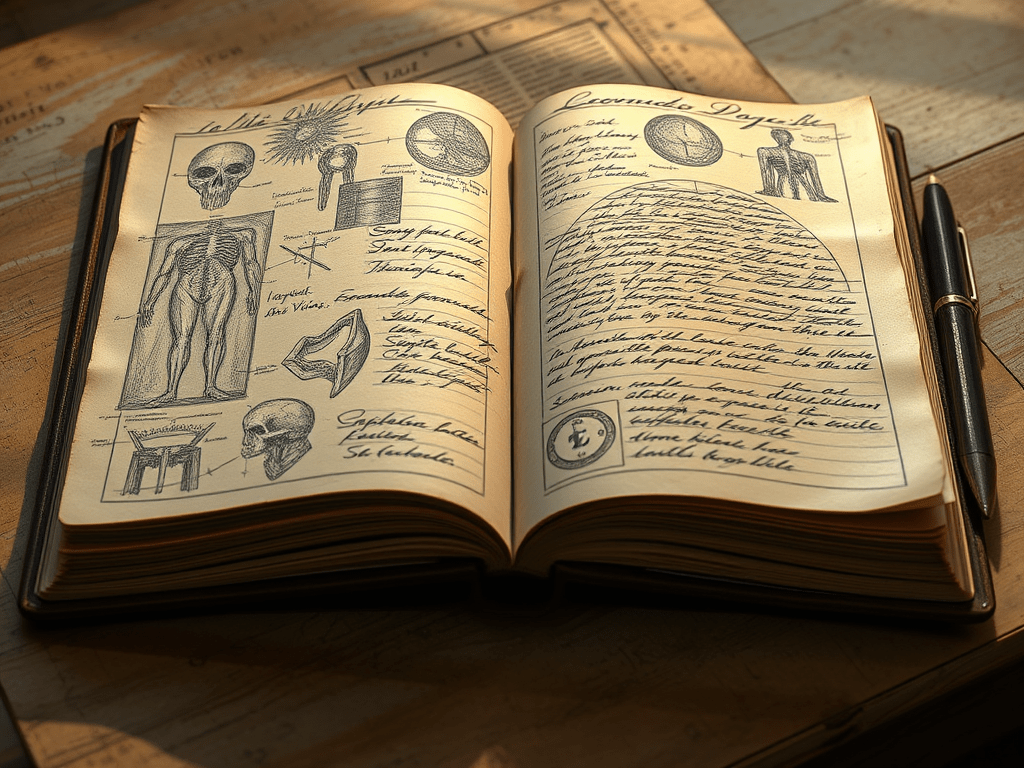
How do you remain creative in a world that wants to stifle you? How do you become unstoppable?
Document everything.
How Leonardo da Vinci Documented His Work
Leonardo da Vinci’s approach to documenting his ideas was as innovative as the work itself. His famous codices (notebooks) captured a vast array of observations, sketches, and writings across disciplines like art, science, engineering, and anatomy. Here’s how he documented his work:
- Multidisciplinary Focus:
Leonardo didn’t limit his notebooks to a single topic. Instead, he blended disciplines seamlessly. A single page might contain anatomical sketches alongside engineering designs, philosophical musings, and artistic studies. - Detailed Sketches:
Visual documentation was at the core of his process. He created precise, highly detailed drawings—whether it was a flying machine, the muscles of the human body, or the swirl of water in motion. These sketches were often accompanied by annotations explaining their purpose or inspiration. - Annotations and Reflections:
Leonardo filled his notebooks with handwritten notes, written in his famous mirror script (backward writing). These notes explored hypotheses, reflections, and step-by-step breakdowns of his experiments, serving as both reminders to himself and insights for others. - Work-in-Progress Style:
Many of Leonardo’s ideas and sketches remained unfinished. Rather than being polished, his notebooks captured the process—a raw, unfiltered look at his thoughts and ideas in real time. This made his work a dynamic record of exploration, not just a showcase of completed projects. - Fragmented Organization:
His notebooks weren’t organized chronologically or thematically. Instead, they were fragmented and spontaneous, reflecting his thought process. Despite this, the sheer breadth and depth of content made them invaluable. - Blending Art and Science:
Leonardo viewed art and science as interconnected. His notebooks demonstrate this fusion, as artistic techniques informed his scientific observations, and vice versa. For example, his anatomical studies improved his ability to depict the human form in art. - A Visual Archive of Curiosity:
Leonardo’s codices are less about conclusions and more about exploration. They capture his insatiable curiosity and his willingness to experiment, fail, and learn. This documentation style allows us to see not only his brilliance but also his humanity.
By documenting his work in this way, Leonardo left behind a timeless archive that inspires creativity, curiosity, and innovation to this day.
 Casemapp: Media
Leave a comment